By John Moore | TheCountryWriter.com
There are five sets of twins in my family.
Seriously. Five sets.
Insert the Arkansas joke here.
My mother is an identical twin. Her mother was an identical. Her mom’s twin had a set of fraternal twins. One of her other children had a set of identicals. And my wife and I have identical twin grandsons.
Growing up around that, I really did just think that lots of lookalikes around me was perfectly normal. So, when my wife called me to tell me our daughter was pregnant with twins, my response was, “Oh, OK.”
Even she couldn’t understand my lack of surprise.
Unless you’ve been around twins, you cannot know the unusual and interesting things that orbit them.
All of my life, my mother and her twin sported the same hairstyle, wore similar or the same outfits and shoes, and drove similar cars. Mistaken identity was common.
When I was a kid in Ashdown, Arkansas, mom worked at a savings and loan on a corner downtown. Her twin worked in the revenue office (where you go to get a driver’s license) nearby. People would go to the savings and loan to get money for their license, walk around the corner, and see the same lady in the revenue office.
It was similar to an episode of Green Acres where Oliver would go to different places in Hooterville and people would mispronounce the same word. The look on his face mirrored the look of those who swore they just saw that lady in another office.
Other interesting things happened. One day, mom filled up at the gas station (back when full service was the norm). She drove away. A bit later, my aunt pulled in with her husband. The attendant asked if her husband knew she was with another man.
There’s a bond with twins the rest of us don’t even come close to having with other humans. Call it ESP, a cosmic connection, or whatever you’d like, but twins are in tune with each other in a way that’s impossible to explain otherwise.
When one isn’t feeling well or is in distress, the other one knows it. How? I have no idea, but I’ve seen evidence of this over and over.
“I need to call her,” my mom would say. “Why?” I’d ask. “Something’s not right,” she’d answer.
Mom would call, and sure enough, her twin was sick or having a problem of some kind. Same in reverse. How they know these things is beyond me, but they do. I’ve also talked to other twins who claim the same mental connectivity. You can scoff, but it’s a fact.
My grandmother and her twin had the same connection. Another connection they had was what TV shows (or as they called them, “my programs”) they watched. And they had to watch them together. If they couldn’t be in the same room, they would call each other on the phone and stay on there discussing what was happening until the show ended.
I learned early on to never ever call my grandmother when The Price is Right was on. The line would be busy. If you called right before the show started and she hadn’t gotten on the line with her twin yet, she’d hang up on you.
“Don’t you know my program’s about to come on?” she’d ask before forcefully putting the phone back in the cradle.
Watching our twin grandsons grow up has been an interesting thing to see. They were the first twins in my family that I was able to observe behavior from birth. They have many of the same interests, think the same, and act a lot alike.
I get it. Genetically, that makes sense. When you’re a carbon copy of someone else, it’s more likely to develop in the same way. But even though they’re identical, they have very different personalities. Just like my mom and her twin. But that can change. As they aged, my mother seemed to take the more dominate role and my aunt the back seat.
Another interesting aspect of twins arose when genetic testing came around. As a gift for my mom and dad, I bought them subscriptions to an online DNA site. The idea was to learn about our ancestors and maybe find new kinfolk we didn’t know we had. Both of those happened. One thing I didn’t expect was a notification I received about my DNA.
When my mom’s twin’s son (my cousin) joined the same site, it showed he was my half-brother.
Identical twins are really and truly identical.
It is interesting that I have a cousin who is even closer biologically to me than any other person on the planet besides my sister.
If you have another Arkansas joke, please put it here.
© 2026 John Moore
John’s new book, Write of Passage: Volume 3, is available on Amazon. Write to John at TheCountryWriter.com.
Enjoying this column? Let us know. Support your local community newspaper — subscribe to Murphy Monitor.
]]>Murphy residents can pick up free native trees in 3-gallon containers as part of the city’s Arbor Day observance.
The 100 trees will be available, first-come, first-served, from noon to 5 p.m. on Friday, Nov. 6, at the Community Center, 205 N. Murphy Road.
Supplies are limited, so the Parks and Recreation Department advises residents to come early for the best selection.
Species available include Chinese Pistache, Vitex Chaste, Crepe Myrtle, Chinkapin Oak and Red Oak.
The city of Murphy is proud to have been recognized as a Tree City USA for 15 consecutive years.
The city handed out seedlings in 2024 and last year the Parks and Recreation Department encouraged citizens to join tree-planting projects in Central Park and the Timbers Nature Preserve.
While most of the nation marks Arbor Day in April, Texans wait until fall to celebrate the importance of trees.
Texas observes Arbor Day on the first Friday in November, when cooler temperatures and seasonal rains offer the best conditions for planting. The tradition recognizes the state’s challenging climate, where spring heat and dry soil can be tough on young trees.
Arbor Day began in Nebraska in 1872, when J. Sterling Morton, a newspaper editor and later U.S. Secretary of Agriculture, proposed a statewide day for tree planting.
The first celebration saw Nebraskans plant an estimated one million trees. The idea spread quickly, and in 1885 Nebraska made Arbor Day a legal holiday.
President Richard Nixon proclaimed the last Friday in April as National Arbor Day in 1970, but states soon realized one size didn’t fit all. Texas formally established its November observance in 2013, though many communities had long planted trees in autumn.
Across the state, schools, civic clubs and city governments mark the day with ceremonies, community plantings and environmental programs that highlight the vital role trees play in daily life: cleaning the air, reducing heat, sheltering wildlife and beautifying communities.
Stay informed, and support your local community newspaper, subscribe to The Murphy Monitor
]]>By John Moore | TheCountryWriter.com
When you’re a kid, the one thing you want to be is older. This is the case for most people until you wake up one day and wish you were younger.
Youth is a long line of mile markers, each of which you are constantly try to reach.
In the 1960s, the youth of Ashdown, Arkansas, had few things to get excited about. A one-income family focused on housing and groceries. Fun things were a luxury.
Six Flags Over Texas is an amusement park in the Dallas area. It’s now quite large and has other parks in the country. At the time it was relatively small. But it was huge to us.
The excitement generated by the announcement that as a family we were going, our church group was headed there, or our scout troop was making the trek, caused chatter for the entire time leading up to departure.
But you learn that excitement needs to be tempered with reasonable expectation.
My dad was six feet tall. My mom is 4’11”. Until I was about 13, I was short. I often wondered if I was destined to be as tall as my dad or my mom. The answer was somewhere in the middle. I grew six inches in one year and made it to 5’10”. I’ve shrunk since then.
That height wasn’t achieved until after early trips to Six Flags. So, I faced the dreaded signage that no kid wants to see when it comes to being able to board the cool rides.
“You must be at least this tall to ride this ride.”
There was little else more humiliating than stepping up to that sign, placing your back against it, and being told you were under the line.
Having to stand back and watch your friends board the Cyclone, Mini Mine Train, or other legendary park attraction, was brutal.
I wanted to be old enough to grow past that line. Eventually, that day came. But there was always the next mile marker.
In addition to being short for about half of my school years, I was also one of the youngest. My birthday fell right on the line when it came to starting school. My mom had to decide whether to let me start or to hold me for the next school year. She later told me that she felt I was ready, so she enrolled me in first grade when I was barely six. When I was coming up, there was no preschool or kindergarten. You went straight into the first grade.
Mom was right. Academically I was ready, but because of my birthdate, I was always one of the last in my class to get to do certain things.
At the time in Arkansas, you could get a driver’s learning permit at 14. Because my date of birth fell much later than my classmates, I had to watch them drive by while I walked to school.
Seeing them cruise down the road behind the wheel of their parents’ Ford LTD or Buick Electra felt humiliating. In reality, it wasn’t. It was just my lack of patience.
Later, I watched as others turned 16 first and got their own hunting and fishing licenses. I did both under a child’s permit.
It was the age of 18 that most of us couldn’t wait to be. Unlike today, at that time you could buy beer at that age; move out of the house, register to vote, or join the military without your parents signing for you.
All mile markers we couldn’t wait to reach.
But something happens as you hit all of those markers. There are always more.
College, marriage, children, a career, and then retirement. You speed towards each like a bullet train.
Those mile markers pass. And then an odd thing happens. You look up for the next mile markers, and you don’t see any.
When I was young, I would say, “I can’t wait until I’m 14 so I can get my driver’s permit.” My grandmother would respond, “Don’t wish your life away.”
That sentence makes little sense to a person who’s focused on the next thing. But the good news is, when you reach a certain age, the next mile marker is an eternal one. The ride you take to get there is one of His forgiveness, not anything you have to achieve.
And you don’t have to be taller or older. Just patient.
© 2026 John Moore
John’s new book, Write of Passage: Volume 3, is available on Amazon. Write to John at TheCountryWriter.com.
Enjoying this column? Let us know. Support your local community newspaper — subscribe to Murphy Monitor.
]]>The college anticipates no increase in its property tax rate if its bond proposal passes, while county projections show the debt-service tax rate could rise gradually over several years to help pay for the proposed county projects.
Both bond elections will include state-required ballot language stating, “THIS IS A TAX INCREASE.” However, the anticipated tax impact depends on each entity’s debt obligations, revenue growth and future tax rates.
Collin College’s $600 million Proposition A would fund the second and third phases of its Destination 2030 master plan. Proposed projects include expanded workforce training and career and technical education programs, an aviation academy in McKinney, and new or expanded campuses in communities such as Anna and Royse City.
College officials project the district can maintain its property tax rate of 8.122 cents per $100 of taxable property value if voters approve the bond package. The rate has remained unchanged since 2018, according to the information provided by the college.
Under that projection, a homeowner would not pay a higher tax rate specifically to cover the proposed college bonds. However, an individual’s total property tax bill could still change if appraised property values increase.
County projects proposed
The county’s bond package would fund a broader range of infrastructure and public facilities. Voters will consider four separate propositions totaling $817.5 million.
Proposition A would provide $296.5 million for court facilities, adult detention and mental health and medical facilities at the jail. Proposition B would allocate $475 million for non-tolled road and bridge construction and improvements.
Proposition C would provide $6 million for parks and open space projects, while Proposition D would allocate $40 million for county election operations and a records-storage facility.
County administrators project the debt-service tax rate could increase from the currently adopted rate of about 4.18 to 4.19 cents per $100 of taxable value to as much as 4.95 cents by 2031. That would represent a potential increase of about 0.77 cents per $100 of taxable value as bonds are issued over several years, through fiscal 2032.
At that maximum projected increase, a home with a taxable value of $350,000 would incur about $27 more annually in county debt-service taxes. The actual impact would depend on the taxable value of the property and the tax rate ultimately adopted.
The projections are not guarantees that the county tax rate will reach the maximum. County officials have indicated that continued population and revenue growth could allow the county to slow the pace of bond sales or cover debt obligations without implementing the full projected increase.
The bond proposals also come after the Collin County Commissioners Court voted 4-1 to increase the county’s overall operations and maintenance tax rate for fiscal 2026-27 to 15.1414 cents per $100 of taxable value. That rate is separate from the debt-service rate used to repay bonds.
For homeowners, the key distinction is that the college expects to finance its proposed bond package without raising its current tax rate, while the county’s proposal could lead to a gradual increase in the portion of the tax rate dedicated to debt repayment.
The Nov. 3 election will determine whether voters authorize the proposed borrowing. The eventual tax impact will depend on debt issuance schedules, property values, revenue growth and the rates adopted in future years.
Early voting will continue through Friday, Oct. 30. Election Day is Tuesday, Nov. 3, when polls will be open from 7 a.m. to 7 p.m. Voters can find early voting locations and additional election information through the Collin County Elections Department.
Stay informed, and support your local community newspaper, subscribe to The Murphy Monitor
]]>By John Moore | TheCountryWriter.com
Broadcasting on Sundays was once a sea of sermons. If you turned on your radio or television, you’d hear or see a minister delivering his weekly message. From sunup (when stations signed on) until at least noon, it was solid preaching.
Today, depending on where you live, it’s still a lot like that. But the once unthinkable programming decision to air something other than a church program eventually crept into our Sabbaths.
Unless you grew up during the mid-20th Century, it’s hard to understand how many different church programs there were. We only had three television channels (ABC, CBS, and NBC affiliates), but there were lots of different radio stations. And for every broadcasting outlet, there were sometimes dozens of preachers.
Most were local ministers, but some had regional followings. A select few had national ministries. When I got into the radio business in the late 1970s, I learned about all of them.
Today, almost every radio or television station is on-the-air 24/7. That’s a fairly recent thing. When I got started, we signed on KMLA, the radio station in Ashdown, Arkansas, at 5:30 a.m. and signed off at midnight. I suspect the reason this was done was money. If you turned off the station for six hours, that was one guy you didn’t have to pay.
Maybe there were other reasons, but that always seemed to be the most logical.
If you were the new guy on the air staff, you almost always began your career working Sunday morning sign-on. This meant that you had to have the radio station on the air by 5:30 a.m. so that you could begin airing all of the church-sponsored programs.
While the rest of the fellas were sleeping off a Saturday night hangover, you and Mr. Coffee were at the station cueing up and playing the different church shows. They ranged from God’s News Behind The News (a syndicated message that interspersed the latest news with scriptural interpretation) to Powerline with Brother John Rivers. Powerline was a music countdown show that included current pop songs that could be played in mixed company. Most of the tunes were generic and soft rock ballads.
The most unique thing about working Sunday morning sign-on was that many of the local preachers did their shows live. Meaning, they actually came to the radio station in their suit and tie and sat behind a microphone and preached for their 15 minutes or half-hour.
Since ministers are used to having a congregation to preach to, a radio station presented somewhat of a unique situation. Their congregation was still getting ready for church. So, the only person they had to preach to was me.
Now, I was not in a suit and tie, and wasn’t exactly what you’d call presentable on Sunday morning. I usually rolled out of bed at 5:10 a.m., shoved a stick of Juicy Fruit in my mouth, put a ball cap on my head, and pulled on a pair of pants and T-shirt to go to work.
In other words, I represented a pretty good sinner. It was Sunday, I wasn’t at church, and I was underdressed. So, the ministers who came to preach live (including my pastor) always stared right at me when they preached.
The radio station control room sat at the front of the building, but between the front door and the control room was the newsroom. And the newsroom was where the pastors sat in front of a microphone to deliver their sermons.
It went something like this:
Me: “We now join Brother Jackie Adams from Bethel Missionary Baptist Church in Ashdown, Arkansas, for today’s sermon. And now, Brother Adams.”
Brother Adams: “If you’re not in church today, let me encourage you to turn away from being backslidden and come visit with us.”
He looked right at me every time he said it. I don’t think it helped that I had a Marlboro Red dangling from the corner of my mouth and the smoke was wisping through my eyebrows and long hair.
There were at least five ministers who did their shows live, and each must’ve listened to the previous preacher, because they almost always seemed to include a rebuttal or retort for what the guy before them had to say.
Not a surprise when you had Church of Christ, Pentecostal, Baptist, Methodist, and other assorted faiths.
But it kept me on my toes, and they got the word out for their side of things.
Where I live now, Sunday still includes radio and TV preachers, but not nearly as many as it did years ago. This week, tune in the radio and TV preachers. They’re fading from the dial.
If you really want to feel like they’re talking to you, throw on a T-shirt and ball cap. But leave out the Marlboro Reds. They’re bad for you.
© 2026 John Moore
John’s new book, Write of Passage: Volume 3, is available on Amazon. Write to John at TheCountryWriter.com.
Enjoying this column? Let us know. Support your local community newspaper — subscribe to Murphy Monitor
]]>By John Moore | TheCountryWriter.com
Red Skelton. Ed Sullivan. Dean Martin. Rowan & Marrtin. The Smothers Brothers. Carol Burnett. Flip Wilson. Make the connection yet?
Variety shows. American variety shows.
From the 1940s to the 1980s, Americans were entertained by a cross-section of talent, all compacted into one hour or more of television. And every week, our RCA console TV in the house on Beech Street in Ashdown, Arkansas, was tuned in to most of the variety shows. Especially Red Skelton. My sister and I loved Red.
Red Skelton was an American comedian who made his way in entertainment through just about every medium. Radio, motion pictures, and television were all conquered by Red, and some amazing talent made it to the big time thanks to being featured on his variety show.
Many who were on Red’s program didn’t need the publicity, but that’s what made a variety show a variety show. The Rolling Stones, The Beach Boys, The Supremes, Mickey Rooney, Vincent Price, and Carol Channing, were just a few of the entertainers who appeared on The Red Skelton Show.
But the weekly favorites were characters that Red came up with and performed himself. Freddie the Freeloader was a silent, yet lovable clown. Clem Kadiddlehopper, a happy, but dimwitted bumpkin. Junior, the Mean Widdle Kid, and Sheriff Deadeye, an incompetent Wild West lawman, were always a treat to watch. Regardless of what my sister and I were doing, we stopped and plopped down in front of the television to watch Red.
The Ed Sullivan Show was also a favorite. Best known for the American debut of The Beatles, Ed’s program was one of the longest-running variety shows, and included the TV debut of many other acts, such as Elvis Presley, The Jackson Five, The Doors, and Jerry Lewis and Dean Martin.
Later, Dean Martin would host his own variety show where he famously refused to rehearse. That lack of rehearsal gave his appearance in a tuxedo, with a ubiquitous drink and cigarette, seem more like a playboy who’d walked into another part of his day rather than a weekly television program.
Dean’s skits and singing, with beautiful women at the ready, were a must-watch in 1960s America.
Rowan & Martin’s Laugh-In took the variety format to a whole new level. In addition to guest stars who appeared (including presidential candidate Richard Nixon), terms such as, “You bet your sweet bippy,” “Sock it to me,” “Here come da judge,” “One ringy-dingy, two ringy-dingies,” “Look that up in your Funk and Wagnalls,” and “Goodnight, Dick,” all became part of the lexicon.
The Smothers Brothers Comedy Hour was very popular, and highly controversial. Tom and Dick Smothers played instruments and told jokes, and had great writers, including a very young Steve Martin. But poking fun at the U.S. Government and the Vietnam War didn’t fly well, and they were canceled.
One variety show that stood out was The Carol Burnett Show. With her regular cast members of Lyle Waggoner, Harvey Korman and Vicki Lawrence. Carol often welcomed Dick Van Dyke and Tim Conway as guests. Conway became a regular cast member much later in the show’s run, but his skit with the dentist who stabs himself with the numbing agent, and his ad libbing during the Mama’s Family skits are now legendary.
The Flip Wilson Show was one of the biggest surprises of the early 1970s. It’s unlikely that anyone thought a man dressing up as a woman named Geraldine, who threatened to sick her boyfriend Killer on those who disagreed with her, would have become a hit show. But it did. My mother never understood why I liked it so much.
Flip was on Thursday night and was the top show, until a new program about poor people struggling during The Depression knocked it off its perch. The Walton’s was also an unlikely hit, but it came around about the time that variety shows were running their course.
As is the case with cop shows, westerns, medical dramas, and other genres of television programs, things come to an end, and then sometimes come back around. So was the case with variety shows.
When The Carol Burnett Show ended its run in 1978, it was the last of the true variety programs. Carol and others, including Dolly Parton, The Mandrell Sisters, and The Smothers Brothers tried to revive the format later, but all attempts fell flat.
But just as cop shows were big in the 70s and fell out of favor, they now have made a big return with CSI, NCIS, and others. Maybe there’s still hope for the variety show.
A cross-section of talent, without the politics, would be most welcome.
© 2026 John Moore
John’s new book, Write of Passage: Volume 3, is available on Amazon. Write to John at TheCountryWriter.com.
Enjoying this column? Let us know. Support your local community newspaper — subscribe to Murphy Monitor.
]]>By Allison LaBrot | [email protected]
Several area districts offer opportunities for seniors to attend school-sponsored events at a discount or for free. Wylie ISD and Garland ISD, specifically, issue cards to seniors ages 65 and older, active-duty military personnel and veterans that act as a general admission ticket to athletic and fine arts events.
Wylie ISD cards are accepted at Garland events and vice versa.
Plano ISD issues discount cards to residents 60 or older.
“Each district may have slightly different criteria or name for obtaining a card, but the goals are the same: to make sure our senior citizens stay connected to our schools and provide affordable entertainment options for this valuable community,” Ian Halperin, Wylie ISD executive director of community relations & marketing, said.
Wylie ISD has issued 200 Gold Cards this semester and more than 3,200 total since beginning over 40 years ago. Eligible residents can apply online at wylieisd.net/goldcard or by contacting Halperin at 972-429-3019. The application contains a few short questions, and the process is the same for seniors, active-duty military personnel and veterans.
The district also allows its retired teachers to apply for the Gold Card. Recipients can choose to have the card mailed to them or to pick it up at the Educational Service Center. Once issued, the card never expires.
In addition to high school events, the WISD card also covers junior high activities that have an admission fee. Halperin said there are some events where licensing requirements prevent the free admission benefit from being used.
Plano ISD has a Retired Seniors Valued in Plano (RSVP) program for residents aged 60 or older. The free membership card allows for free or discounted admission to most PISD sporting and fine arts events.
Members recently took a hosted by Superintendent Theresa Williams and Johnny Hill, deputy superintendent for business, employee services and technology.
Attendees visited Plano West Senior High School, Haggard Middle School, Plano Senior High School and the new Career and Technical Education Center.
“I found it absolutely fascinating to see how much construction is occurring in Plano, as well as the unique types of construction,” said RSVP member Mark Ball “You’ve got schools that are being rebuilt featuring brand new things that I didn’t think about when I was in school, or my wife Jane, who was a former principal in the district, even was aware of. It really is an opportunity for the students to have such wonderful campuses.”
PISD RSVP Membership Cards do not expire and membership does not have to be renewed annually. The program provides free admission to all home games for all sports for middle school and high schools, both junior varsity and varsity. It excludes away games, playoff games and non-school events held in school facilities.
Fine arts events hosted by the UIL are regular price with no discount or free admission, but campus performances of plays, variety shows, band, orchestra, choir and vocal music offer free admission on opening night. The RSVP offers discounted admissions only on opening night for musicals and the Drill Team Spring Show.
For more information, or to apply for a card, search RSVP on PISD.edu.
To receive a Garland ISD VIP pass, eligible residents can call 972-494-8580 to schedule an appointment during the window of Monday through Thursday from 9-11 a.m. and 1-3 p.m. Applicants must bring a government-issued picture ID or document to prove military service. Garland’s VIP passes also never expire.
For more information, visit garlandisd.net/garland-isd-vip-pass.
Reporter Bob Wieland also contributed to this story.
Stay informed and support local journalism — subscribe to Murphy Monitor.
]]>Murphy’s annual family campout is returning to Central Park Pond next month, offering families a chance to spend a night under the stars without venturing far from home.
Now in its third year, the overnight event has become a popular fall activity. Last year’s campout offered space for 50 families and sold out quickly.
This year’s event is scheduled for Friday, Nov. 13, through Saturday, Nov. 14, with an evening of outdoor activities, food and entertainment planned for participants.
Campers can begin checking in at 3 p.m. Friday, with fishing and yard games available until dusk. The s’mores pit opens at 6 p.m., followed by dinner at 6:30 p.m. An outdoor movie is scheduled for 8 p.m., although the film has not yet been announced.
Quiet hours begin at 10 p.m., giving campers a chance to settle in for the night.
The following morning, breakfast will be served at 7 a.m., with campers expected to pack up and clean their campsites by 9 a.m.
Registration costs $50 per campsite for up to five campers and includes a complimentary dinner and breakfast, along with a commemorative T-shirt. Vegetarian meal options are available upon request.
Participants should bring their own camping supplies, including a tent, sleeping bags or cots, flashlights, insect repellent, extra clothing, jackets and lawn chairs. Fishing gear, water bottles and any necessary medications are also recommended.
Parking will be available at the PSA North Lot, 330 N. Murphy Road, with overflow parking at the Murphy City Hall Complex, 206 N. Murphy Road.
Registration is open to Murphy residents and nonresidents, with a deadline of Thursday, Oct. 15. Campsites can be reserved through the city’s website at https://bit.ly/4hwVuFQ.
Stay informed, and support your local community newspaper, subscribe to Murphy Monitor
]]>By Carrie Dunlea
North Texas, summer’s relentless heat has finally begun to loosen its grip. Mornings turn cooler, evenings invite an extra layer and suddenly sitting beside a campfire sounds like a very good idea.
It’s camping season.
Fall may be the sweet spot for exploring the outdoors across Texas and its neighboring states. Hiking is considerably more pleasant without triple-digit temperatures, chilly evenings make sleeping under the stars more appealing and, farther north, hardwood forests trade summer green for shades of gold, orange and crimson.
Best of all, a memorable fall escape doesn’t require a flight or a week off work. From the red-rock canyons of the Texas Panhandle to the cypress-lined waters of East Texas and colorful mountains of Oklahoma and Arkansas, some spectacular places to pitch a tent — or park an RV, rent a cabin or even go glamping — are just a road trip away.
Here are seven worth packing for.
Palo Duro Canyon
There’s camping, and then there’s waking up at the bottom of a canyon.
Known as the “Grand Canyon of Texas,” Palo Duro Canyon drops dramatically from the flat Panhandle landscape into a world of multicolored rock walls, mesas and rugged trails. The canyon is the second largest in the country and can be explored on foot, mountain bike, horseback or by car.
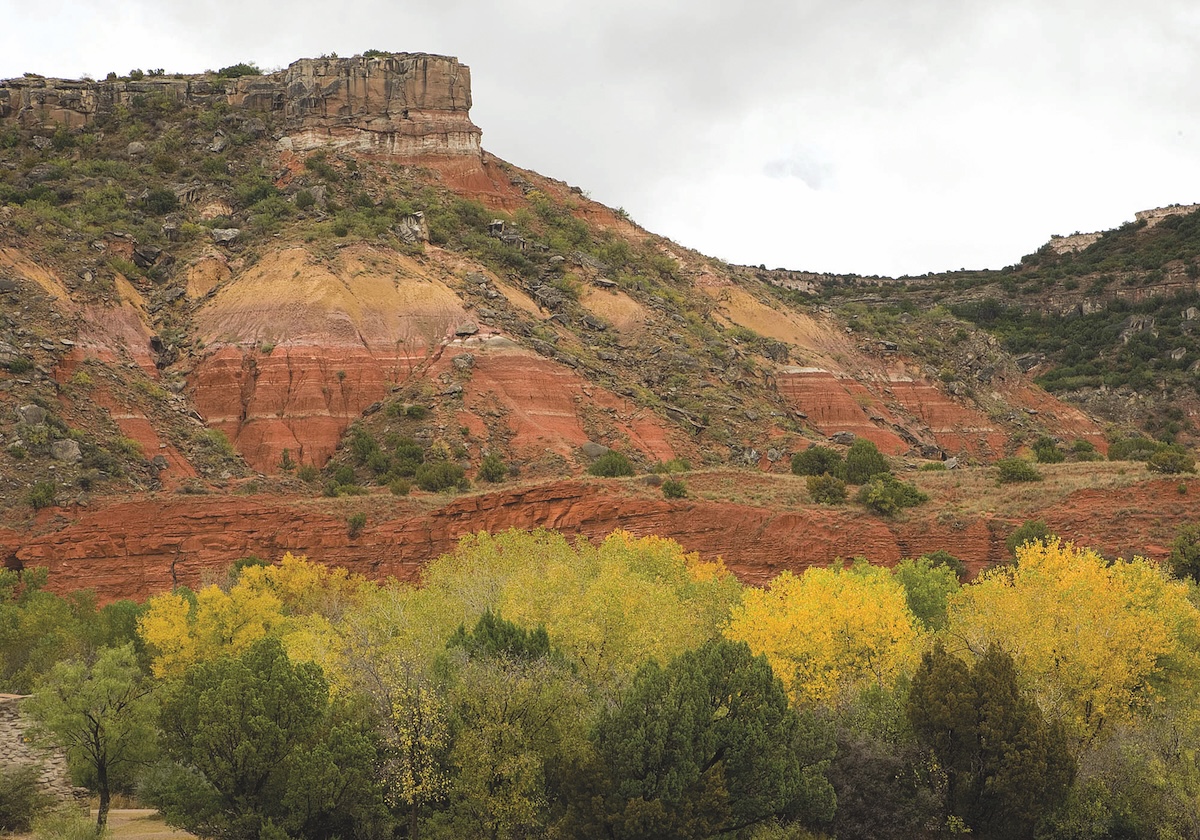
October brings a major advantage: more comfortable temperatures for exploring trails that can be punishingly hot during summer.
Campers can choose from developed sites with water and electricity, drive-up tent camping or primitive backpacking. Those who like the idea of nature more than sleeping on the ground have alternatives: cabins sit along the canyon rim and floor, and furnished glamping sites come equipped with beds, air conditioning, refrigerators, grills and covered porches.
Stay outside after sunset. Away from city lights, Palo Duro’s enormous night sky may be as memorable as the canyon itself.
Caprock Canyons
About 90 miles southeast of Palo Duro, Caprock Canyons offers another dramatic Panhandle landscape — with some very large residents wandering through it.
The park is home to the Texas State Bison Herd, descendants of animals preserved by legendary ranchers Charles and Mary Ann Goodnight beginning in the late 1800s. Today, bison roam more than 10,000 acres of the park and have the right of way when they decide to cross a road.
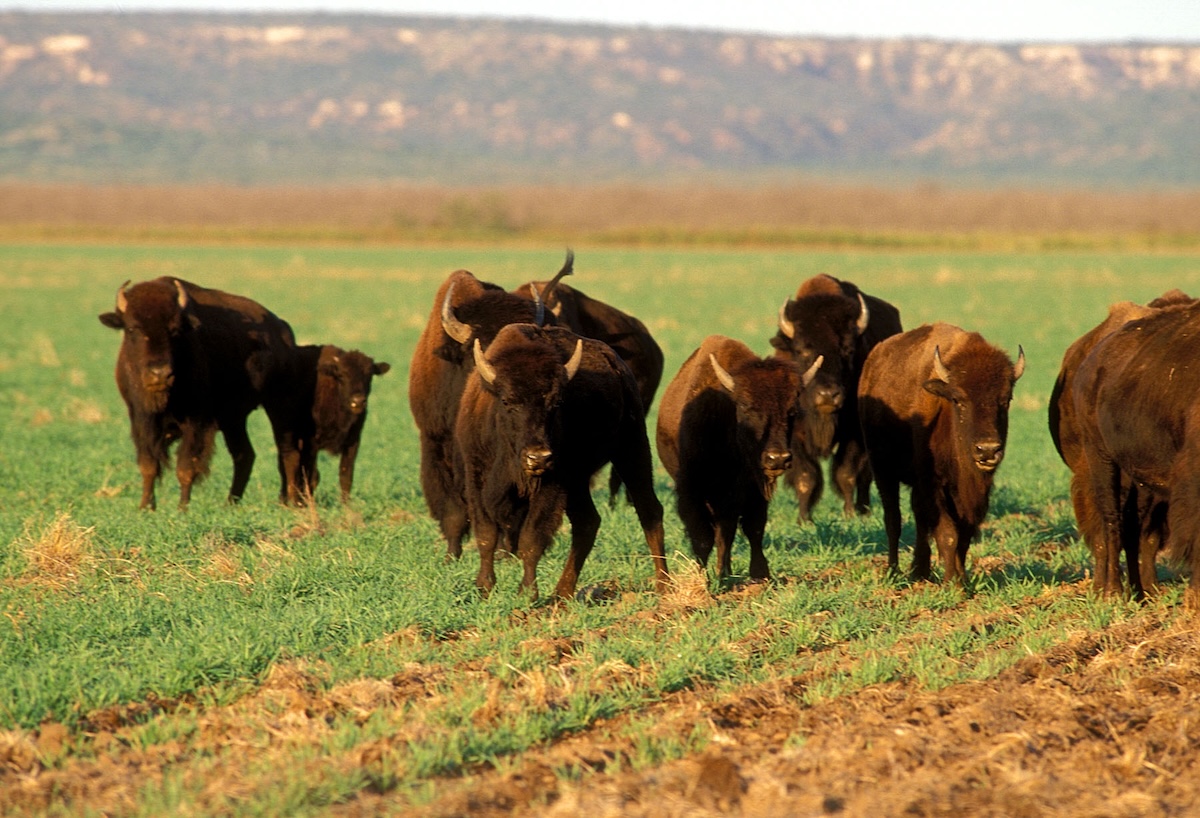
The landscape is reason enough to visit. Red and orange canyon walls rise above prairie, cottonwoods and Lake Theo, while nearly 90 miles of park and trailway routes offer opportunities for hiking and mountain biking. Campsites range from sites with electricity to walk-in and true backcountry options.
Fall brings another splash of color as cottonwoods turn yellow against the red canyon walls.
Just remember who’s in charge here: Park officials advise visitors to stay at least 50 yards from bison.
Trade canyon walls for Spanish moss at one of Texas’ most distinctive camping destinations.
Caddo Lake
Caddo Lake feels almost otherworldly. Massive bald cypress trees rise from dark water, their branches draped in Spanish moss, while a maze of bayous and wetlands begs to be explored by canoe or kayak.
The 500-acre state park provides access to the much larger Caddo Lake ecosystem. More than 70 species of fish inhabit its waters, and paddlers can explore Saw Mill Pond and Big Cypress Bayou or venture onto longer paddling trails.
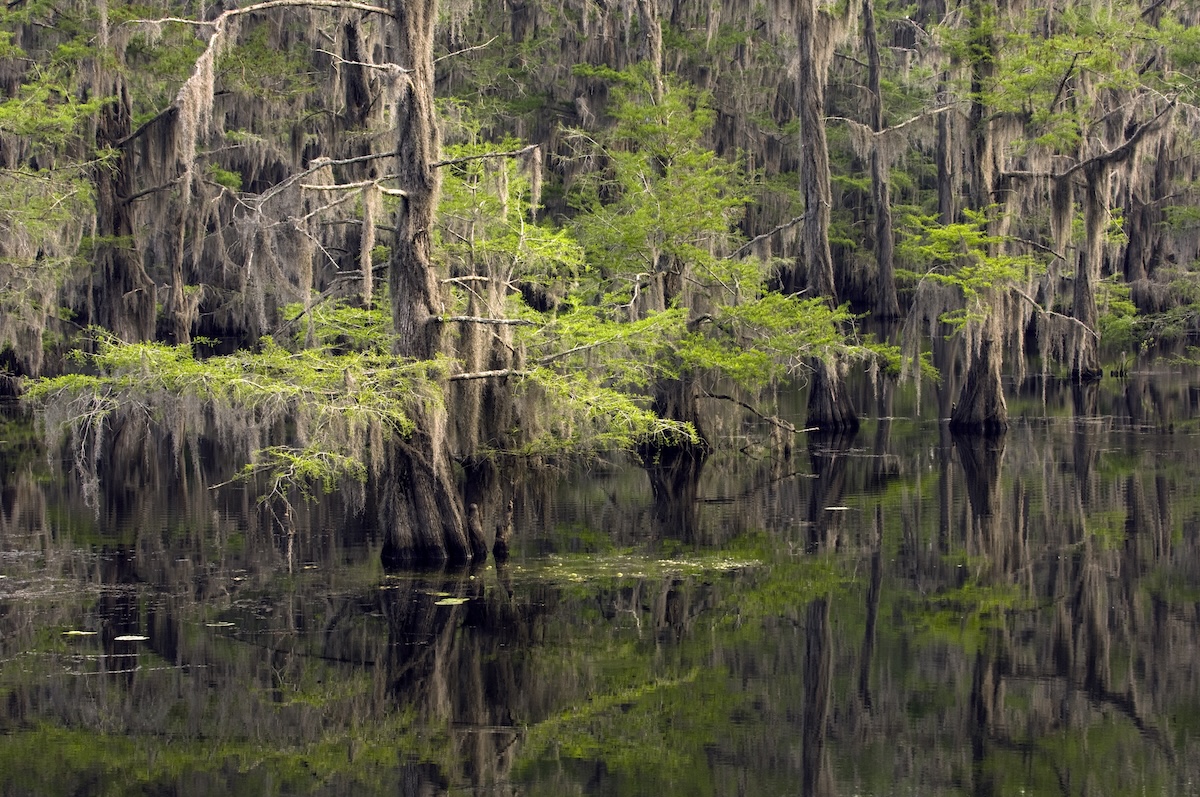
There are 46 campsites ranging from basic water sites to full RV hookups, along with screened shelters and historic Civilian Conservation Corps cabins for travelers who prefer four walls.
A word of caution before wandering too close to the water: Alligators live here, too.
For campers accustomed to North Texas lakes and prairies, Caddo offers something completely different without leaving the state.
If your vision of fall involves tall trees, a rushing river and a campfire beneath changing leaves, point the car toward southeastern Oklahoma.
Beavers Bend State Park
Beavers Bend State Park sits along the Mountain Fork River and Broken Bow Lake amid the forested hills of the Ouachita Mountains. The combination of water, woods and winding mountain roads has made the Broken Bow area one of Oklahoma’s signature fall destinations.
Days can be spent hiking, fishing, kayaking or canoeing, followed by an evening around the fire. The Mountain Fork River is also known for year-round trout fishing. In autumn, the surrounding forest supplies the show as greens give way to gold, orange and red.
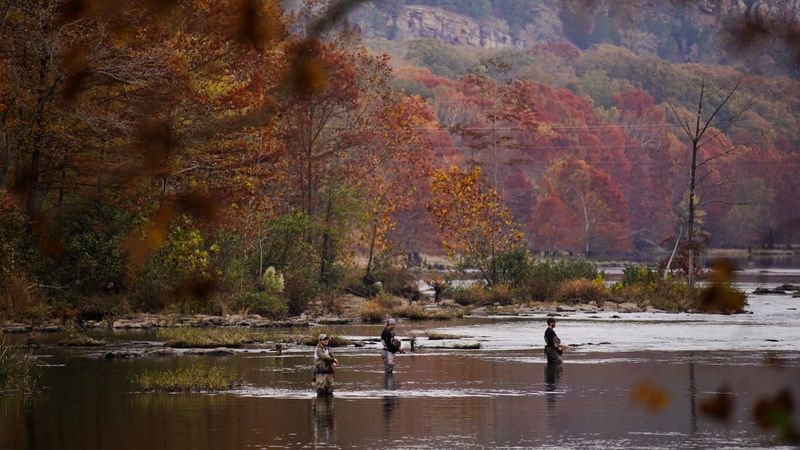
The park accommodates campers ranging from tent enthusiasts to RV travelers, while cabins provide an easy alternative for anyone who wants the outdoor experience followed by a real bed.
And with Broken Bow and Hochatown nearby, restaurants and other diversions aren’t far away if camp cooking loses its charm.
Come for the fall color. Stay for the outlaw lore.
Robbers Cave State Park
Tucked into the Sans Bois Mountains of southeastern Oklahoma, Robbers Cave State Park combines rugged cliffs, wooded trails and lakes with stories of an era when outlaws supposedly found refuge among the area’s rocky hideaways.
A trail leads to the cave associated with notorious names including Jesse James and Belle Starr, but autumn may steal the spotlight. Oklahoma tourism identifies late October into early November as a particularly good period for viewing the surrounding hills in their fall colors.
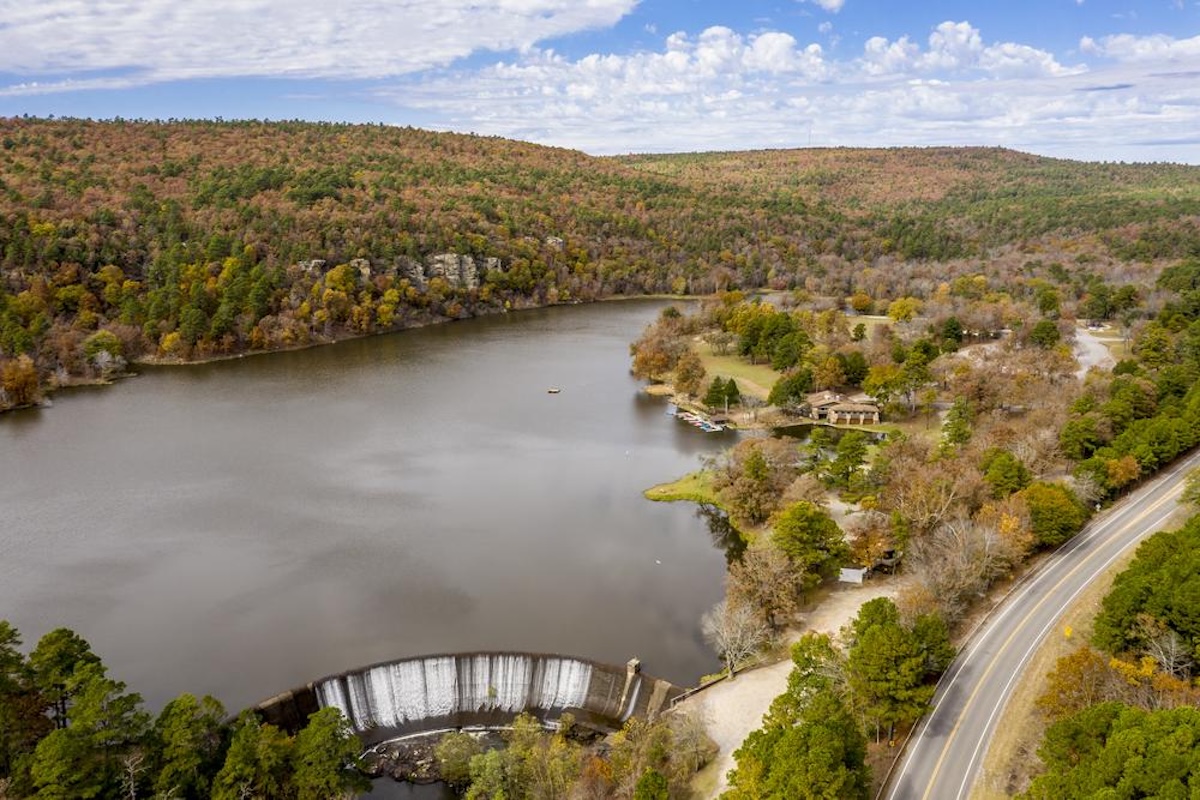
Hiking and horseback riding offer different ways to explore the terrain, and adventurous visitors can try rappelling. Seasonal canoe and paddleboat rentals continue Thursdays through Sundays through October in 2026.
Camping options are plentiful, but those who decide they’ve had enough rustic living can retreat to a cabin or the park’s lodge.
For a classic autumn camping trip, it’s hard to improve upon Arkansas’ first state park.
Petit Jean Mountain
Petit Jean Mountain rises above the Arkansas River Valley, creating a landscape of wooded trails, overlooks, rock formations and waterfalls. In fall, the surrounding hardwood forest supplies the color.
The signature hike leads to Cedar Falls, where water plunges 95 feet into the canyon below. Other trails lead past caves, rock shelters and overlooks, making this the kind of destination where it’s easy to fill a weekend without ever leaving the mountain.
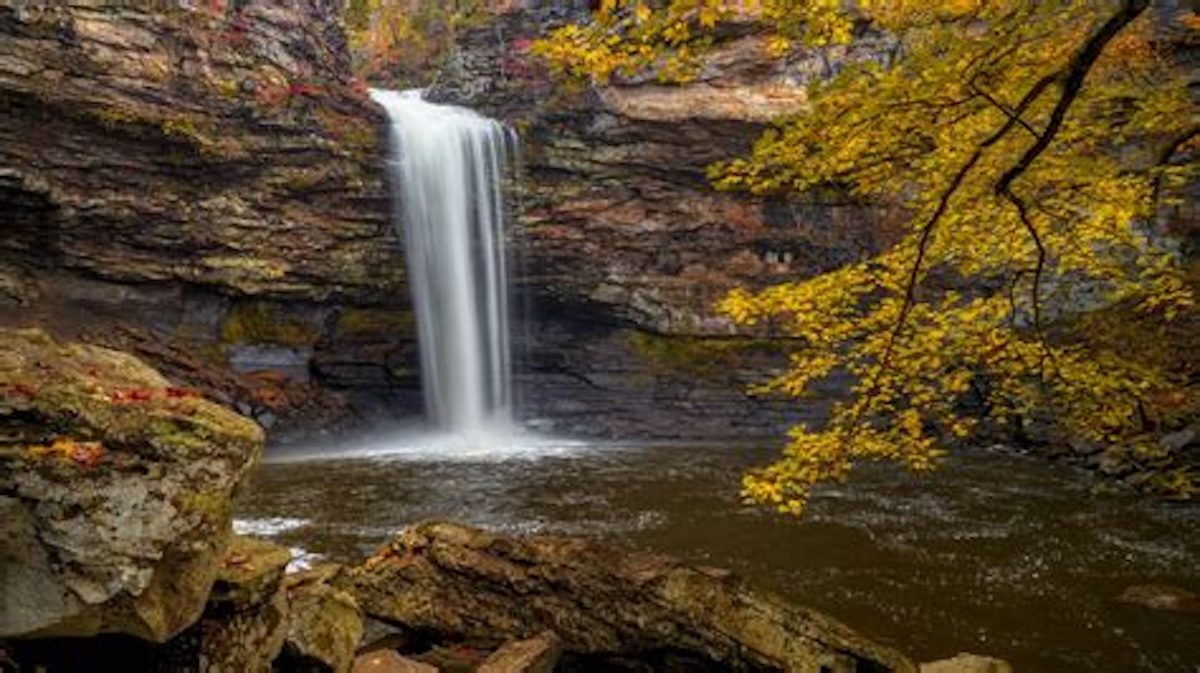
Petit Jean also carries the fingerprints of the Civilian Conservation Corps. Rustic stone and log structures constructed in the 1930s remain part of the park experience, including historic Mather Lodge.
That makes Petit Jean especially appealing for a mixed group: Campers can sleep beneath the trees while companions who aren’t quite ready to embrace tent life can opt for a cabin or lodge room.
Pack hiking shoes. You’ll want them.
Devil’s Den
Deep in the Ozark Mountains, Devil’s Den looks almost purpose-built for October.
The park occupies a wooded valley surrounded by rock formations, bluffs and forest with trails winding past creeks and the geological features that gave the park its name.
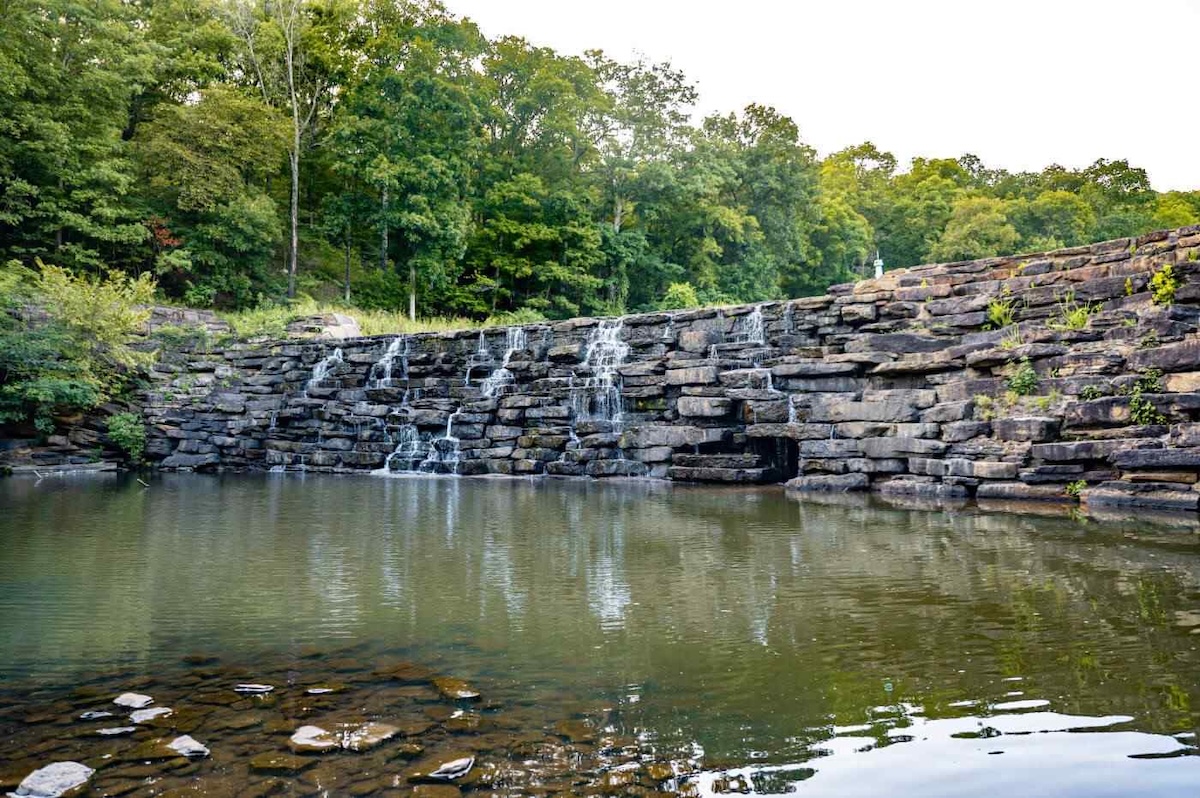
his is a particularly good destination for travelers who want hiking or mountain biking to be the centerpiece of the trip. Trails extend through the park and into surrounding Ozark National Forest, while the park’s CCC-built stone and wood structures lend it an old-fashioned, tucked-away feel.
There are 117 campsites along the valley floor, including sites with hookups, plus hike-in camping. For those who want a little more comfort, 17 rustic cabins and nine camper cabins are available.
When the leaves cooperate, the drive into the park may be nearly as pretty as the destination.
Fall camping has one drawback: Everyone else has discovered how good it is, too.
Popular parks can fill on autumn weekends, so advance reservations are suggested. Palo Duro and Caddo Lake, for example, both warn that they can reach capacity, while Arkansas allows campsites at Petit Jean and Devil’s Den to be reserved well in advance.
Before leaving home, check individual park websites for reservations, weather conditions, burn bans and trail closures. Temperatures can vary dramatically between North Texas and higher elevations or the Panhandle, so pack layers even when the forecast at home still looks decidedly summery.
Then bring the important stuff: hiking shoes, a comfortable chair and something warm to drink.
Summer may get all the attention when vacation season arrives, but around here, the best time to sleep under the stars might just be fall.
Enjoying this column? Let us know. Support your local community newspaper — subscribe to Murphy Monitor.
]]>By John Moore | TheCountryWriter.com
The City of Texarkana dates its official beginnings to 1873. Like many cities and towns of the era, railroads brought people, who brought businesses. The same was true for Ashdown, Arkansas, my hometown, located just north of Texarkana.
The railroad connected people. It brought the mail, needed supplies, and communication. In the 1960s, another communication system came to Texarkana: cable television. The installers strung cable down the utility poles until many homes had the opportunity to connect. By the early 1980s, Ashdown folks also had cable.
Today, we take fast and easy communication for granted. We can call anyone instantly, anywhere in the world. Until cable, 24-hour news was unheard of.
Before cable, my family watched the latest on the Vietnam War on the nightly news. By the latest, I mean a few days old.
The news reader had that distinct news-sounding voice he’d use to introduce the footage. “Here we see this newsreel, shot three days ago in Da Nang…”
The advent of cable television brought us together in a way similar to what radio did in the 1920s, and television in the early 1950s.
Most of the television networks were offshoots of the old radio networks. ABC, NBC, and CBS, strung together with local radio stations.
When you see The Waltons gathered around their cathedral-style radio, that’s pretty accurate. Families gathered in front of their set for entertainment and news, just as they would later in front of the television.
We had three television channels in our area. Local programming during the day and national programming at night. Cable TV changed that in a big way.
Early cable programming was mostly channels imported from the nearest large city. For us in Ashdown, it was the same network affiliates we had, but the channels were from Dallas. This included PBS, which was something we did not have in our market.
PBS shows included Sesame Street, Mr. Rogers’ Neighborhood, This Old House, and Nova. They were excellent and eye-opening. They showed us things we hadn’t seen before. The kids learned. The adults learned too.
One of the most impressive cable channels was Home Box Office, or HBO. At the time, it was the only 24-hour movie channel with no commercials. Until HBO, the only way you could watch a movie without advertising was to go to a movie theater.
The first time I saw HBO was at a buddy’s house. Heaven Can Wait, with Warren Beatty and Julie Christie, was on. A great movie.
Satellite dishes were a popular option for television viewing, but as broadcasters began encoding their channels on satellite transmissions, cable television became the preferred option.
My dad finally subscribed to cable, so we could watch all of the family’s favorite shows with a guarantee that the signal would be crystal clear and reliable. With an antenna, you were at the mercy of the weather when it came to watching your shows. Weather could affect the signals.
Cable also changed the way we watched. Instead of checking a newspaper or waiting for a favorite program to come on, we could flip through channels and find something at almost any hour. There was a new sense of possibility in that. A movie, a ballgame, or a program from another city was suddenly just a button away.
News went from being three days old to live.
One morning, a new channel called CNN was covering a routine speech by President Reagan. They were still covering the event when the president was leaving the building to get into his limousine. On live TV, President Reagan was shot by an attempted assassin.
Just 20 years earlier, President Kennedy was murdered, but the only footage of the tragedy was taken by a civilian. The film had to be developed and shared later.
Cable television grew into more news networks, live weather channels, and very specialized programming. A storm approaching our area could be tracked on television, while news from around the world appeared as it happened. For families who had once waited days for footage, that was a remarkable change.
Today, we have channels for food, history, biographies, and much more. All of which started with cable.
In just a few decades, we went from three grainy channels to YouTube, where we can make our own TV programming if we want.
It’s easy to take for granted how connected we are today. It’s debatable whether we’re better or worse off for the advancement, but one thing is certain: we no longer have to wait three days for the news.
Today, in regard to transportation and communication, cable has just about gone the way of the railroad. Fiber optics and streaming are how we stay connected.
With the coming of AI, who knows what’s next. But one thing is certain. Cable is one of the big steps that got us where we are, and will get us where we’re going.
Enjoying this column? Let us know. Support your local community newspaper — subscribe to Murphy Monitor.
]]>